We visited Kani Orphanage at the Kani Village which is about a 30 min boat ride from Pyapon in the Ayeyarwady Division which is a 3-4 hour drive away from Yangon in south western Myanmar. We also visited Pyinnyar Waddy Orphange in Kyite Latt on the way back. Moegyo (MHF) has been providing monthly support to both orphanages since the Cyclone Nargis in 2008.
Kani Orphanage:
As soon as we reached Pyapon, heavy rain started and continued throughout our boat ride and throughout the most of the day. On the small boat, under the heavy rain, I thought about the cyclone that passed through this area 8 years ago, which took many lives and left many orphans. We passed by villages with small huts, which stood in the water.
When we reached Kani, the members of the board that run the orphanage and the teachers there, warmly welcomed us and showed us around, particularly the high school, that just opened this year, which MHF provided support. Before this, children had to walk 2-3 hours round trip daily to a nearby village to attend high school. We also met 16 students who just passed high school this year. All said they would like to continue the studies at colleges. College tuition (distant learning) is around $120-$150 per year for each student and required for 4 years to graduate.
Teachers and the board repeatedly expressed their gratitude to the donors and volunteers at MHF for the support for the construction of the high school and for the tuition of the high school students. They proudly explained the growing record of high school graduates. Kani has more than 500 students, of which about 160 are under the care of Parahita (the orphanage). Currently, there are 24 college students receiving scholarship from MHF.
Pyinnyar Waddy Orphanage:
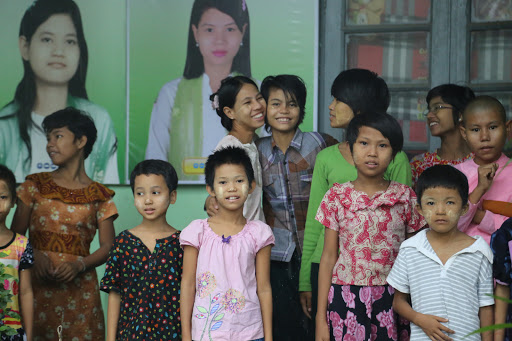 On the way back, we visited the girls orphanage at Kyite Latt, which is a two hour drive from Pyapon. As soon as we entered the compound, we saw big posters of 3 high school graduates, hung outside the orphanage. We met little ones from the age as young as 3-4. Everyone was happy and proud for the graduates, who are now the models for the little ones. The passing record is 100%. We also met one college graduate who returned to the nunnery to take care of the children. Our heart was with these girls since one of the MHF volunteers reported the condition of this nunnery 7 years ago. Monthly support from MHF has relieved some expenses on daily meals and tuition. The nunnery is now hosting 35 girls. We asked what they needed and were told they needed clothes for the little ones and the little ones also asked for toys.
MHF first reports on orphanages (how MHF found the orphanages):
Pyinnyar Waddy Nunnery at Kyite Latt:
Please see below press release issued by the Office of the Resident / Humanitarian Coordinator in Myanmar on Cyclone Giri.
Source: United Nations Information Centre in Yangon (http://unic.un.org/imucms/yangon/80/110/home.aspx)
UN agencies and international and national non-governmental organizations present in Myanmar are mobilizing aid and deploying assessment teams following the Category 4 Cyclonic Storm, which made landfall in Rakhine State on 22 October.
Yangon, 27 October 2010 --- The humanitarian community in Myanmar stands ready to scale up support in response to Cyclone Giri, following new estimates on the scale of damages shared at the monthly Myanmar Humanitarian Partnership Group meeting in Yangon.
The meeting, attended by the heads of diplomatic missions, aid agencies, UN agencies, international non-governmental organizations (INGOs) and other members of the humanitarian community in Myanmar, received an update from the UN Resident/Humanitarian Coordinator and several UN missions and INGOs on the actions being taken in the immediate aftermath of the cyclone.
The four most affected townships in Rakhine State are Kyaukpyu, Minbya, Pauktaw and Myebon. UNHCR, FAO, WFP, UNDP and UNICEF are already present in the region and are mobilizing relief efforts. Similarly, several international and local NGOs have been sending teams to the area to carry out rapid assessments and provide food and non-food items.
Preliminary reports from assessment teams on the ground indicate that the number of people affected could be higher than initially estimated. The Myanmar Red Cross Society (MRCS) is currently collecting assessment data in seven townships in Rakhine State, seven in Magway Division and four in Sagaing Division. To date, a total of 71 villages are reported to have been affected, to various degrees, with an estimated 177,000 people affected, of which an estimated 10,000 are considered severely affected.
Although there is severe damage to infrastructure, it is reported that major loss of life has been avoided, due to early warning and an extensive evacuation of a large number of people carried out by the Government and the Red Cross in advance of the cyclone reaching the shores. The Government has also mobilized relief efforts, with a number of Ministers still on the ground in the affected areas, and has welcomed the offer of assistance from humanitarian organizations present in Myanmar.
“Good lessons have been learned from Cyclone Nargis in terms of disaster risk reduction, as evidenced by the advance deployments, evacuations from high-risk areas and distribution of relief to affected villages. The UN and its partners are ready to scale-up support, and we urge the authorities to facilitate continued access to the affected areas for both international and national staff as was done in the case of Cyclone Nargis,” said the UN Resident/Humanitarian Coordinator, Bishow Parajuli, who also commended humanitarian partners for quickly setting up sector-specific coordination structures, both at Yangon and field level.
“The most important immediate needs are in the emergency shelter, water and sanitation, food and health sectors, while early recovery including agriculture and livelihoods should also be addressed. We encourage donors to stand ready to support activities on the ground,” said Parajuli.
For more information, please contact:
The United Nations in Myanmar
It has been two years since the worst natural disaster in Myanmar history, Cyclone Nargis, killed 140,000 people and left millions in need of assistance in Myanmar. On this day two years ago, on 2 May 2008, the lives of many families in Myanmar delta region changed forever. Many lost their loved ones and livelihoods. Heart breaking stories of how parents losing children and how children losing parents were told by the survivors and the first responders. Images of horror caused by the deadly wind and quick-rising water, of the rescue efforts, of the people with blank expression on their faces were widely circulated on the Internet. Songs were sang. Stories were written. Pledges were made.
The world has moved on, in a way. We have since seen other natural and man-made disasters with huge magnitude of damages in other parts of the world. We should help them. All of them. However, on this 2nd anniversary, we would like to make a special appeal not to forget the victims of Cyclone Nargis in Myanmar.
Sadly, the United Nations reported that two years after the disaster, funding gap hinders recovery in Myanmar:
"the United Nations aid coordinator in Myanmar said today that just a quarter of the pledged funds have come in and the gap threatens the long-term revival of the area hit by the disaster." "According to recent assessments, 100,000 vulnerable families still need to rebuild their homes." "Some 180,000 people still face acute water shortage, and there is a great need for agricultural support and the creation of income – generating opportunities at the community level."
Read the full story here:
h ttp://www.un.org/apps/news/story.asp?NewsID=34543&Cr=nargis&Cr1=
Please find here the 3 year Post-Nargis Recovery and Preparedness Plan - PONREPP, launched by the UN, Myanmar Government and the Association of South East Asian Nations (ASEAN). (PDF, 4.14 MB): http://www.aseansec.org/CN-PONREPP.pdf
The task seems daunting but every bit of assistance counts. What can one do to help?
(a) Donate your time or money to any organization helping to rebuild the societies in the areas affected by the cyclone;
(b) Visit the areas yourself, if you can, and see and assess the situation for yourself;
(c) Form a group wherever you are and raise funds and awareness in the local community about the disaster and the need for assistance.
Thank you.
Together, we can make a difference!
The Moegyo Team
 There are rehabilitation programs being carried out by various parties including some heavy-weight companies in all parts of delta region. The farmers are being helped with buffaloes or plowing machines, seeds and manpower. Yet, there are always some pocketed areas where help could not reach as fast as it should. All of us can try filling in these blanks and help others do this as well.
That said, it was reported that in 10 villages visited in Day-da-ye area, there are 6 primary school (Grade 1 to 5), 3 extended primary schools (Grade 1 to 8), and 1 high school (Grade 1 to 11). Total number of students in all these schools is around 2,000. Some are still coming in to register in the schools at a later date, so the number still fluctuates.
 All these school buildings had collapsed during the cyclone except the buildings from the high school. All the students studying in primary schools are in the shelter of monasteries in the villages. As schools have started, some text books have arrived to the high school, but most of these text books got wet and were destroyed. Other primary schools have not received any text books yet. You will see in the pictures: the teacher uses a game board as a blackboard; some students are in a shelter house (za-yat) without any walls; and some are studying on the concrete floors.
(Photos credited to UKMG.)
We will have an assessment report on the number of students in each grade by next week. One set of text book costs between 1,000 Ks per set to 1,500 Ks depending on the grade. Let's try filling in the blanks.
We had a chance to speak to a chief monk who is residing in Yangon. His assistant monk was born in one of the villages near Bogalay. This monastery has been collecting donation and kinds from their contacts and have made frequent trips to the villages around Bogalay and Haing-Gyi-Kyun area. They have been donating/distributing rice bags, and other food items, clothings and school materials. And from time to time, they would chant prayers (pa-reik) and offer some soothing words in the villages.
The monk's birth place village has luckily gone through the cyclone without a single death. But most villagers' possession and huts/houses were swept away during the event. The villagers now have a roof above their head, so their priority is to get back to work as soon as possible. The monk has made a right remark saying that when the villagers are given the opportunity to work in the field, it is for the long term. It will offer a stability to their income and their livelihood.
There are a few ways one can involve in making this happen: by arranging for them to buy seeds (for growing rice), by buying them plowing machines (partially mechanical, each one cost about 1,600,000 Ks.) and by buying them necessary fuel for the plowing machines. While this is an important part about the rehabilitation phase, one has to be sure we buy the correct species of the seeds, the correct type of machines, etc. One will also have to show the villagers how the plowing machine works. This program involves a lot of technical expertise and time to do this, but the benefits make such a good impact on the families.
Hope all of us can share and look into the possibilities.

May 31st trip - After checking emails, headed toward Thanlyin-Kyaut Tan for a quick tour -Left Yangon quite late and had to catch the flight in the evening. - So, decided to drive through the main road, where saw some cars from Save the Children went into off-main road. - At one monastery (badly damaged), saw some people/crowd and decided to stop-over and check. -There were about 150 Nyaung Wine villagers (Kyaut Tan township) and some donors distributing food and clothes. -Asked villagers of their needs and as usual they replied that they are quite OK in terms of food, clothes and shelter(I doubt though), but they want someone to assist rebuilding of their neighbors' houses (about 4 of them). That truly shows the selfless nature of our people. - Each house will cost about 100,000 kyats. - Kyaut Tan-Ye Le Pagoda area was pretty quiet with only a few visitors. Some people there said the monasteries need donations. - Due to time-pressure, had to head back to Yangon. Wish had more time to visit the villages.

We would like to focus mainly on providing with school materials for the kids. There is still time because school starting dates are postponed for the effected areas. The adults are going to adjust to the recent changes in their lives. The kids are also going to. But without the right channel and care, their adjustment can be harsh and painful for their minds. So, in addition to helping them with obvious material needs such as school materials, building schools and huts/houses etc, there must be some further care we can offer to them. Are there any illustrated educational books to console them from what they are going through in real life? These children have to live in very bad health environment and most them were traumatized by the situation.
Can we produce posters, booklets that the kids rely on, that they can learn from? Anything? UNICEF produces very informative posters for the schools here (info on washing hands, eating hot foods, using proper toilets etc). Please send us any suggestion.
It has been a roller coaster week with a lot of mix emotions, but I hope you would all agree that we have done our best to provide emergency food aid to Myanmar cyclone victims in the past four desperate weeks. In addition to (1) distributing emergency aid, in the coming weeks we will be expanding our operations into (2) rebuilding (building budget huts) and (3) restoring lives (helping families and children)
1. Distributing aid
We are continuing with our emergency aid operation, and we still need all the help we can get. We will continue to collect food, clothes and medicine and ship all the collected supplies to Myanmar. We collected a lot of clothes, shoes and medicine from Bangkok donors (SVC Asia Co., Ltd, UNESCAP families, Bangkok Brazilian Community) and made two shipments to Yangon last week.
2. Rebuilding (building budget huts)
After talking to numerous victims by our volunteers, most of the victims want to rebuild their lives. But houses being wiped out, crop and boats destroyed, equipments lost, it is hard to get back to their lives. We URGENTLY need to rebuild the houses in order for them to return to their farms. For the current and following year, they must start the harvesting cycle now.
We decided to first focus on a village, which had lost about 400 people and now left with about 100 survivors. This village is only accessible by boat, and one of the worst hit areas about 5 hours by boat from Latt Putta. There are about 30-40 women and some children who have been displaced and staying in Lattbutta area while the men will get back to the village to rebuild their houses. The houses will be built using Bamboo for the frame and Da-Neet or Tarpaulin for the roof. All the men agreed to stay at the village until they are comfortable to bring their families home.
Each hut is about 20 x 15 feet with attached kitchen and good for 12 people. Cost of each hut is about US $170. We allocated US $ 4000 yesterday for Group 4 (hut building group) to rebuild the huts. At the moment Group 4 is arranging supplies from near by towns. Getting there alone is quite an adventure and takes about one day because they have to watch the tide condition.
3. Restoring lives (helping the families and children)
The cyclone destroyed a lot of roads, bridges and houses but most of all - families. A lot of children are left orphans and their fates uncertain. We will need to help these families especially those with young children. Sometimes, for some families the situation is life and death and for some is to get back to their status quo. In any case we will try and help them restore their lives.
For the children that lost their parents, we’ve learned that it is best for the children to be cared by their relatives other than the orphanage. With this in mind, we will try to help the families and vulnerable children buy providing with their day to day essential needs.
From various sources, we have learned that there are about 3000-5000 orphans left behind by this cyclone. We can’t confirm this large numbers but we know a few places where there are about 200-300 kids. Not every one has a relative or village to go back to so they must be placed under good care. We must support the orphanages or build one to protect our vulnerable children.
Every dollar, every minutes count and together we can make a difference. We hope you would all agree and support any one of our plans. All suggestions and comments are most welcome. Please also see our action at "Donation and Distribution Report".
Some cars were stopped yesterday evening and they were eventually let go after their wheel tags were registered. Recently, there have been some cars distributing some flyers to the by-standers on the road. I don't know how effective passing out those flyers were, but now donations are being frowned upon, again... So, some people who plan to go out today cancelled their trip. Everyone is waiting to see what is the real situation.
"The following is the translation of the latest blog entry from Nyi Lynn Seck titled "Budget Huts Plan". NLS has agreed to post it on MOEGYO blog. It's a good recount of an aid worker's experience and his on-ground thinking. The original blog entry is at http://nyilynnseck.blogspot.com/2008/05/budjet-hut-plan.html. MOEGYO is contributing funds for this plan. "
Budget Huts Plan:
 From now on, we plan to build affordable huts for survivors of the cyclone, rather than giving them food and clothes. When we ask them what they need most, they tell us that they most urgently need housing and want to return to their farms.Out of a population of 500, one village has only 100 survivors left. About 30-40 are women. Most of the female survivors we met, don't want to return to the disaster areas yet, the place of their grief. Most of the men want to return even if authorities forbid them.
There are 2 kinds of cyclone victims - those who have reached the city and others who have not bothered to make it to the city. Everyone you meet in the cities aren't victims and every victim is not yet in the cities.We meet the real suffering victims upon travelling to the villages. Some villages have received aid from planes but it is not enough. Some villages are still not accessible due to the road conditions. These victims grew up and made their living on the rivers and lakes, therefore they don't seem overly worried about food. So long as there are rivers, finding fish and shrimps are not difficult. They are mostly worried about not being able to return to farming. They have to remove the salt water from the farmlands which were overswept by the rising tides. They then have to plow the soil. To do all that work, they first need a place to stay with a roof over their heads.
Obstacles
Building a house had its own obstacles.
- One was transportation. Some seaside villages require about five hours to get to by normal boats. Since many boats drowned during the cyclone, there are not enough boats to go around. It would be costly to permanently rent a boat. The first village that we built huts for - had a boat fortunately, and we only had to pay for fuel.
- Second obstacle was getting bamboo. The cyclone devastated many bamboo forests. Therefore, bamboo was hard to find. The distance of bamboo (from the village) would bring up the cost. The reason for choosing bamboo over wood will be explained later.
- Third obstacle was general use items. These are now very expensive in affected areas, so we are having to transport them from Yangon.
Group housing
 The huts we built are not for single family use. Our discussions with the survivors tell us that they do not want to move whole families back to the village. Their plan is for the men to return first, a village's men will form and work together on a community farmland of 10-15 acres (they used to work on hundreds of acres on their own before), and they will continue to expand and grown on this year's crop. I look at them and I get goosebumps. Even in such disaster, they are forming long-term plans, why can't we plan long-term too? So, we discussed with them and they told us that they want to live together in group-houses, not one-family-one-house yet.
They won't live in these group-houses forever. But about 3 years for sure. After that, they will try to build separate houses. We therefore agreed upon building affordable huts for 2-3 year living.
Our budget huts are 20 x 15 feet. A kitchen of about 6x6 feet is attached. Hut will be built using bamboo. Tarpaulin <http://en.wikipedia.org/wiki/Tarpaulin> will be used for roofs and covers.
Why da-neet?
Some are asking why "da-neet" is not used.
- The reason is simple, many houses in these areas had their roofs redone with new batches of da-neet for the upcoming monsoon season - just before the cyclone hit. Thus, da-neet leaves that are growing now are fresh and still not hard enough to use for housing.
- Second reason is lots of women who used to make living as da-neet weavers have perished in the disaster, thus there's nobody to weave da-neet. So, tarpaulin - a bit more more expensive, but faster, easier and workable - was substituted.

Reason for using bamboo instead of wood is that wood is more expensive and hard to transport. Even if wood was donated from Yangon, it'd be difficult to first transport wood to Laputta, then to villages that need it. These victims don't have any money. Any matter that would unnecessarily complicate their minds should be avoided.
Budget
We call such huts 3x2 and 1-attached. Meaning there're six small rooms in a hut (with an attachment). One room is big enough to comfortably house 2 persons. A hut can house 12 people. Building five huts cost about 1,000,000 kyats ($850). A hut costs 200,000 kyats ($170) and one person's cost will be about 20,000 kyats ($17). These are actually really affordable housing.
These are more necessary now than big permanent houses (taking months to build) for them. The villagers can build the huts themselves. We provide the meals while they are building. By having them take part in building these huts, they also get a sense of contribution and understand that not everything can be given to them as gifts. After such huts are built, we will work together with other related NGOs to arrange sanitation and water.
Let's help
 The cyclone took many lives. However much they are controlling their emotions, they have suffered much emotionally. Parents, siblings, spouses perished right in front of their eyes. We cannot feel we have done our jobs just by returning their lives to normal. We have to work and help them achieve something extra out of their losses. If their sanitation was not proper before, and it remains unchanged now - that'd mean surviving this ordeal didn't make any change in their lives. Nothing improved. We need to help them improve their state of mind, living standards and education. That's the only way their surviving of the cyclone would make any sense.
In other countries, there exist groups which console and help the victims. Why don't we have such groups? I'm saddened by this fact.There're about 100,000 displaced refugees. If we built such "budget huts" for every one of them, the bill will amount to 2 billion kyats. Our funds are minute compared to that huge number. But we will build as many huts as we can afford. If you wish to donate huts, you can calculate based on the information above, and donate for x number of villages, x number of huts, and so on. You don't have to send it though us either. Anyone can go down to these villages and analyze the on-ground requirements, and make useful contributions to help the victims.
One of our fellow groups shared the information with us:
I hope you don't mind me responding again, from my child protection experience. In Myanmar it is so difficult to avoid putting children in institutions because infrastructure is so weak. I used to work with street children (in Myanmar) and we struggled with this issue all the time.
However, again, please encourage people - whoever is going to the affected areas or delivering aid.
They should encourage families to keep their children with them, even though it is hard to feed them and they (the families) think that orphanages (or other people who offer to take care of their babies) may be able to help. Families are the best people to take care of children. Orphanages all round the world, and including in Myanmar, often have children who are not true or 'double orphans' but have a family member living. Due to the pressure to educate and feed their children parents and families put their children in institutions.
I believe that the monastic system, and also the many other religious groups - like the Christian groups, do an amazing job to take care of the poor, and especially children. There are a number of agencies, international and local, who work on this issues and for any long term support any institution should contact them. If people are providing funding, remind them that it is difficult to sustain support over the long term (you have to take care of those children for the next 18 years!)
So some messages (given in encouragement):
Encourage families to keep their children with them. Encourage people who are giving aid to prioritise and take into account those families who are taking care of extra children (including orphans).
Encourage people to be careful of allowing children in their community to go with individuals they don't know (I know from colleagues in Myanmar that traffickers are operating).
Encourage those wishing to start up institutions to try and reunite children with their families, in the short or long term. I know that the International Red Cross, Save the Children and World Vision are all working to support tracing activities to help children find their families.
I hope that these messages are understood. I've worked in other countries after emergencies and many people want to help, but sometimes that help can be less helpful than they realise. I honestly believe that orphanages and institutions should be the places of last resort. I know that Myanmar families and communities do an amazing job of keeping their children in their communities, and I also know (from personal experience) what a fantastic and unique support the religious institutions provide. I had many positive experiences of working with the monasteries...
Warm regards,
Local vs. Overseas if items are also available in local markets:
Some items are more expensive overseas. In Myanmar, there're locally made substitutes or "made-for-Myanmar" products that are less expensive. Transportation costs and time can also be saved. Plus, buying in local markets will also support the local business.
What they don't need:
Chocolates, biscuits, beauty products, luxury items.
What they need urgently:
· Food (some areas are getting enough from donors, remote areas are not). Main diet consists of rice, vegetables, meat, nga-peet. Anything along that line would be good.
· More urgently - "da-neet" and bamboo for building huts.
· Clothes (new or old).
· Boats. It's the same everywhere. People in easily accessible areas are getting aid. But those in the remotest regions are barely surviving, because they are hard to get to. Only boats and helicopters can reach these areas.
What they would also like to have:
· Instant coffee (lots of Myanmar rural people drink instant coffee mix everyday! this gives them energy, and some are even addicted to the caffeine)
· Instant noodles (not really necessary if they got their main diet)
· School uniforms, and money for school enrollment, and stationery (schools open in 2 weeks)
· Milk powder (for babies who lost their moms), most rural Myanmar's don't drink milk, Ovaltine, etc.
* Educate recipients to use boiled/bottled water for milk preparation for babies
· Plastic cups for bathing, washing, receiving rice rations, etc.
· Plastic plates and bowls for eating
· Bowls, pans for cooking meals
Some local prices for consideration: (just to get a general idea)
· There's an advertisement in the newspapers for 600-kyats tee-shirts, special pricing for donors.
· Toothbrush - 100-150kyats
· Instant noodles - 150-180 kyats
· Toothpaste - 350-400 ks
· Soap - 200 ks per bar
· Coffee - 130 ks per satchel retail price (whole economy bags bought in bulk are less expensive)
· Blankets – 3,500 ks
· Towels – 3,500 ks
· Mosquito net (single) – 6,500 ks
· 100 "Da-neet" cost about 15,000 kyats
A recent exchange rate was 1140 kyats to a US dollar.
Return to their farms:
The survivors are anxious to get back to their farms. The monsoon is starting now, and they need to plow and sow their farms. Women and children can stay in these refugee camps until alternative housing and/or relief can be made available, but the men have decided to return to the farms to start work. Only then will their livelihoods be back to normal. They need to build big huts housing about 20 men each near their farms. They can build the huts themselves, but they need "da-neet" and other materials. Such materials used to be abundant, but Nargis wiped out whole areas so things are scarce. Da-neet can only be bought from other regions (i.e. Mawlamyine) and transported by ship. But there's no such logistics system yet.
Saving the children:
Many, many children have been made orphans overnight. I'll spare you the heart-wrenching details. Orphanages need to be established to handle the extra load and really help these poor little souls continue their life journey on an even-footing.
Near Mount Popa, there is a monk who has pledged to provide space and sheter for 300 orphans. He will manage it, hire local staff, send the kids to government school which is nearby. He has enough space. But he needs help and donations to build housing and especially procure 6 month to 1 year ration of food. After that, he can take care of the orphanage himself, because enough donations should be rolling in on a regular basis by then (according to the monk).
Information shared by one of the fellow groups:
Just to share the current situation from the group from our side.
From the visit to Kun Kyan Gone and after talking with some of the survivals, the following facts are learnt:
1. Rice trucks are banned on Yangon-Pathein Road at this moment.
2. Aids reach to Kun Kyan Gone township but not around the villages where transportation are difficult (half an hour on boat), where badly cyclone hitted areas.
3. The group goes today with car loaded with foods and water bottle for two target villages around Kun Kyan Gone Township. (5 L equivalent in kind stuffs).
4. Stuffs for distribution are instant noodles, Custom/Super Kwekar, water putirification bottles and candles. At the moment, instant noodle cost in Yangon is 200 kyats per pack, 800 kays for a pack of candle and 3200 kyats for one big pack of kweykar-out (30 small packs included). Prices can be changed subject to the situation and commodities prices.
5. Continues to tighten access to Ayeyarwady Division and other regions impacted by the cyclone.
6. Local authorities pay much more attention to distribuition whith crowd people and ask some queries which could leads to limit our access to those areas.
7. Distribution with large amount of food tons cannot make at one time. That means donor/group has to go there several times with minimum level of food tons.
8. What the group plan to do currently is one the village elders will wait them in Kun Kyan Gone and take them to those villages.
9. They will put the stuffs one of the house or monastery and call young lead people/senior sayardaw who has power from the village and let them to contribute the stuffs and the group will monitor and manage behind it. That leads to direct distribution and quiet.
10. Facts –one of the bridges near Bogalay is very badly damaged. The load of the truck or cars is very limited.
Let's wait and see what the group will tell when they come back.
- The latest news from Yangon is that a group (not ours) went to Kon Chan Kone area on May 13th to donate some rice bags. Right before they run out of supplies the angry crowd started to fight. They had to leave (run) from the area. This is the first we hear this kind of story. Usually all the crowd line up and they were very orderly.
- So far I do not have any information from our distributors in Delta area. The doctors group should be back soon. Hopefully by the end of this week, I will have alot of news.
- My cousin is going to delta area this weekend with his classmates from Medical shcool. They are willing to help in anyway they can. I told them that we will support them if they need any medical supplies. He will let me know.
1. No foreigners allowed in any of the disaster areas.
2. No cameras allowed in disaster areas.
3. Donation / charity groups are springing up all over the country and the world. Many are raising cash. Many are collecting items (clothing, etc). Some items are being delivered to disaster areas.
4. Some areas are still off-limits, as survivors are over-eager to get their share of the distribution that sometimes it can lead to looting. People have reported being stopped at knife-point and asked to give more food / items, in some areas.
5. Once you get in the field, a lot of people come back literally with only the shirt on their backs. I.e. you go there with a jacket and a teeshirt, you only come back with your tee.
6. Bodies are still visibly floating in the water. Will take a few more days for them to sink or decompose.
7.There are 100,000 survivors. For example, $2Million will come to about a dollar per survivor for 20 days. As food prices have soared and no one can grow their own food anymore, a dollar a day is not enough to sustain life. So if we up the burn-rate to 2 dollars per day, the number of days comes down to 10 days. This is just for food. It doesn't include shelter, clothing, funds for business to re-start.
8. We need a few billions of US$ in total. How to get that? That's the big question.
9. Also with loss of human lives, so many many many cows and bulls have perished. These people cannot recover without their tools of trade along with farmlands.
|


